
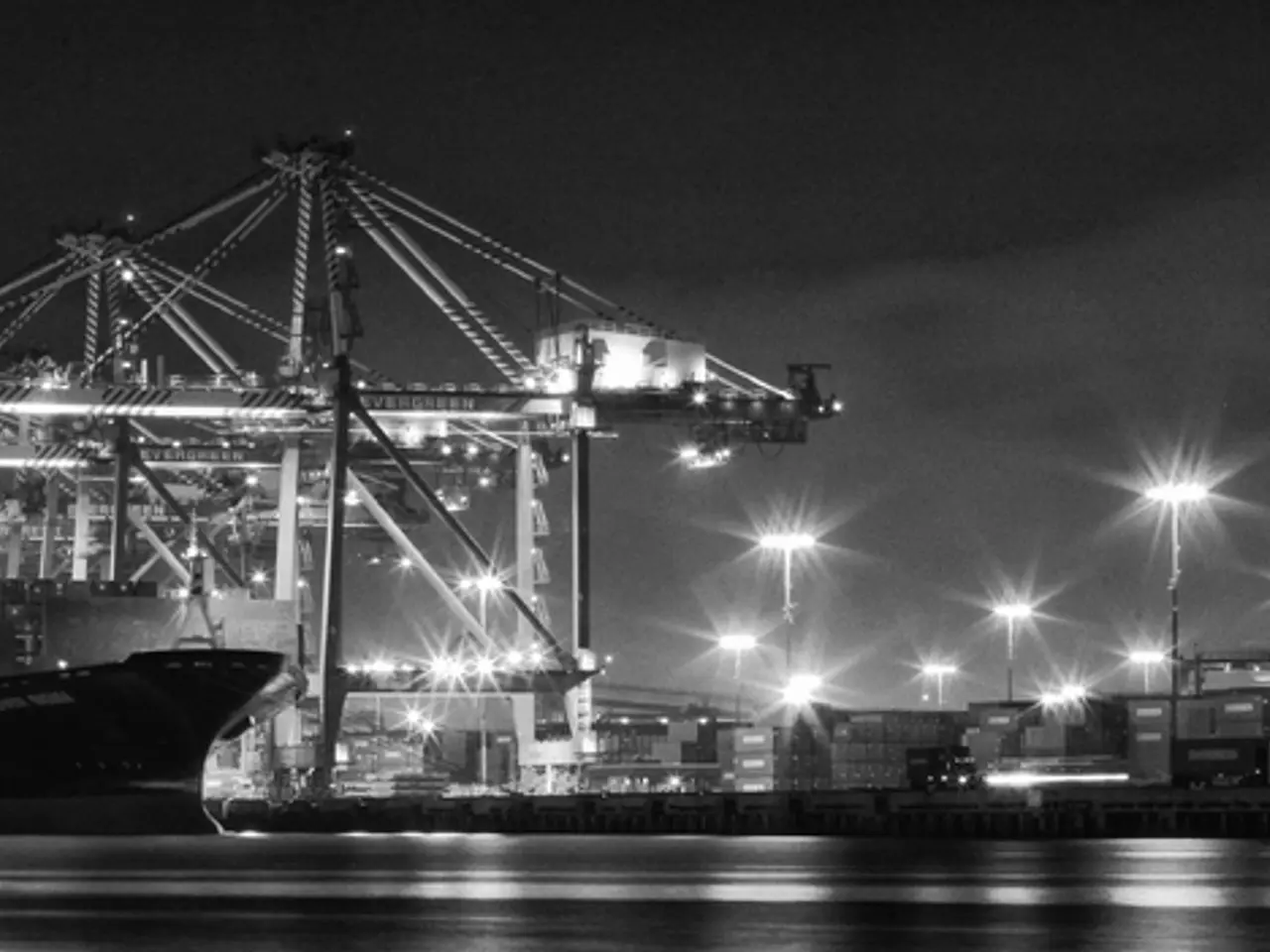
Cape Town's Container Terminal Stuns with 62% Exceptional Performance over Estimated Goal
The Cape Town Container Terminal (CTCT) has made significant strides in 2025, achieving a historic performance and setting a new benchmark for excellence in terminal operations.
Despite challenges such as equipment reliability and weather, CTCT's focus has been on maximizing resources and empowering its people to deliver. The terminal's leadership has prioritized workforce engagement, with daily performance targets communicated and ground support structures reinforced.
In the week ending 20 July 2025, CTCT handled 19,931 twenty-foot equivalent units (TEUs), which is 62% above the target of 12,283, and is the highest weekly volume for CTCT since March 2019. This impressive feat was made possible by the terminal's ability to surpass throughput targets, indicating marked improvements in productivity and workflow management.
Year-on-year cargo volumes at CTCT rose by about 1%, reflecting sustained growth in container movement. The terminal’s resurgence in the 2025/2026 financial year is due to focused leadership, strategic investment, and a renewed commitment to operational excellence.
A substantial financial outlay on new container handling equipment significantly boosted operational capacity and reduced bottlenecks. The terminal has acquired and commissioned 9 new rubber-tyred gantry (RTG) cranes, with 9 more to follow, and ongoing investment in terminal infrastructure includes the acquisition of 18 new RTG cranes.
Local terminal performance and national volume growth in the freight sector also created a favorable environment for CTCT’s expansion, suggesting improved logistics coordination and market demand. In June 2025, refrigerated container throughput at CTCT increased by 64% compared to the same period the previous year.
Terminal Manager, Noxolo Thabatha, stated that CTCT is in a much better position than it was last year. The improved reliability of CTCT has been crucial in supporting South Africa's export economy. CTCT's strategic focus, investment, and empowered leadership have been key factors in its recovery and growth.
The CTCT's resurgence serves as a model of progress within Transnet Port Terminals (TPT), demonstrating the potential for similar improvements across the organisation. With continued focus on operational efficiency and workforce engagement, CTCT is poised to maintain its position as a leading container terminal in the region.
[1] [3] [4] Source: Transnet Port Terminals Annual Report 2025/2026 [2] Source: Cape Town Container Terminal Quarterly Report Q1 2025/2026 [5] Source: South African Freight Forwarders Association Annual Report 2025
- The outstanding performance of the Cape Town Container Terminal (CTCT) in 2025, as reflected by its highest weekly volume since March 2019, is attributed to its focus on maximizing resources, empowering its people, and strategic investments, which have boosted operational capacity and reduced bottlenecks.
- The improvement in the reliability of CTCT, under the leadership of Noxolo Thabatha, has played a crucial role in supporting South Africa's export economy and export industry, while also contributing to the growth of the national volume in the freight sector.
- The CTCT's strategic focus, investment in infrastructure, and empowered leadership have been instrumental in its recovery and growth, making it a model of progress within Transnet Port Terminals (TPT), and positioning it as a leading container terminal in the region.
- The expansion of CTCT is not only a testament to its resurgence in the 2025/2026 financial year, but also indicates promising prospects for energy-intensive industries such as automotive and manufacturing, as well as businesses that rely on effective transportation and efficient finance systems.




