
Economy Minister: Germany Lags Behind in Infrastructure Development Speed
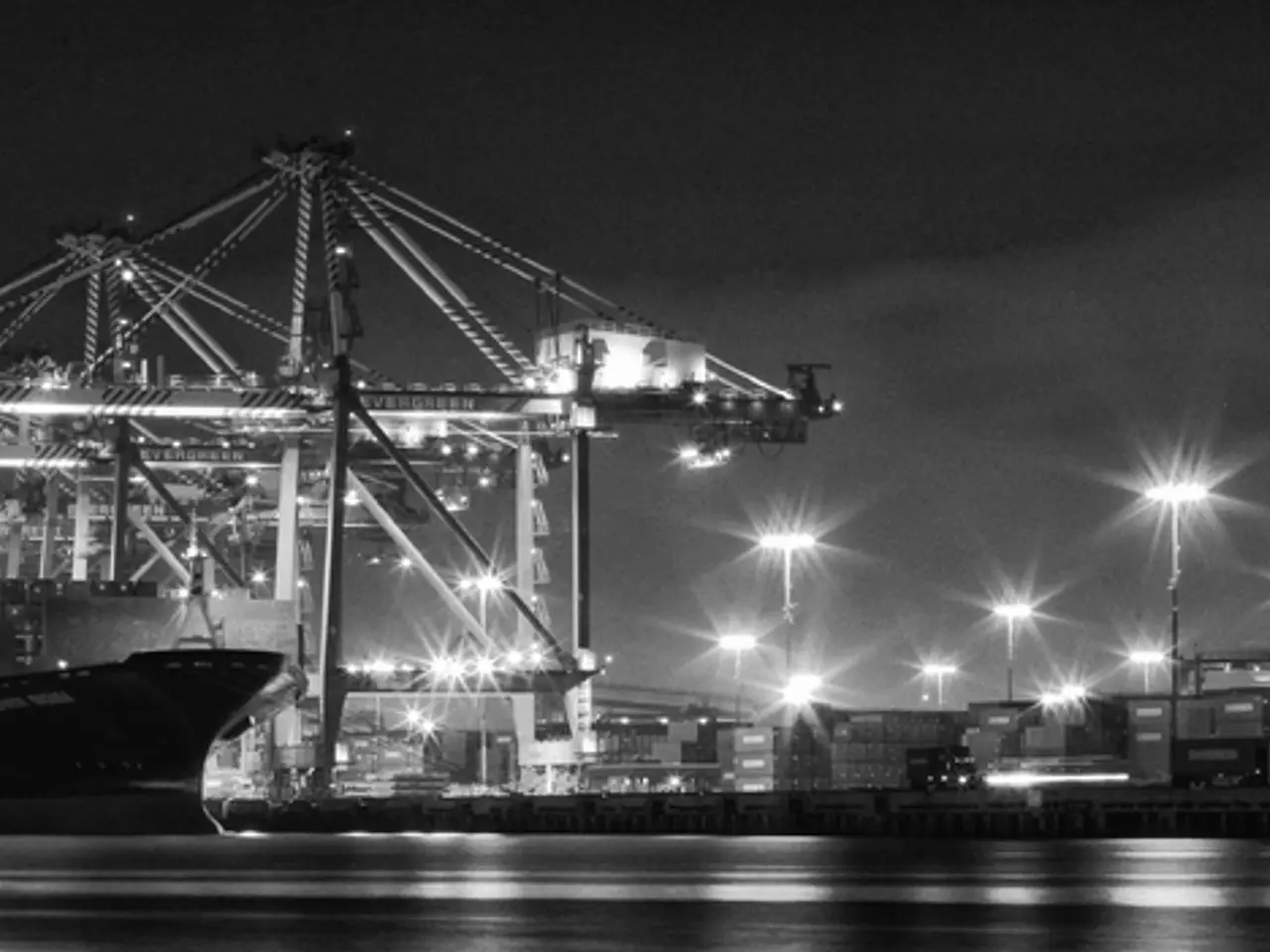
In a visit to the bustling Hamburg Port, Federal Economics Minister Katherina Reiche (CDU) highlighted the need for urgent infrastructure development in Germany.
During her visit, Reiche praised the dynamism at the Airbus site in Hamburg-Finkenwerder, which is consistently digitizing and automating, despite the pressure on the German location. However, she criticized Germany's slow infrastructure development, particularly in the northern states.
Christoph Ploss, the federal government's maritime coordinator, urged these states to utilise the 100 billion euros from the special fund for infrastructure expansion, with Hamburg receiving a share of 2.6 billion euros.
Reiche advocated for structural reforms, calling for measures against high energy prices and burdens from social security systems. She expressed concerns about the weakness of the location due to decreased exports, with both exports across the Atlantic and to China seeing a decline.
Despite the growth in container handling at the Hamburg Port, which increased by 9.3% in the first half of the year, many of these were empty containers. The terminal visited by Reiche, the most modern in Germany according to Hamburg's Senator of Economics, Melanie Leonhard (SPD), is largely automated for container handling.
The federal government has announced additional support for the "green transformation" of seaports, with an additional 400 million euros from the climate and transformation fund.
Reiche also addressed the trade dispute with the USA, noting that exports of loaded containers to the USA decreased by 26.2% due to the dispute. Imports from the USA, however, increased by 0.4%.
Despite these challenges, Reiche emphasised the need for Germany to improve its social security and reduce poverty in old age, with plans for a mandatory pension insurance for new self-employed persons without other retirement provisions from 2025. She also called for the abolition of the gas storage levy by January 2026, supported by a one-time payment of 3.4 billion euros from the Climate and Transformation Fund to balance the levy account by the end of 2025.
Reiche's visit to the Hamburg Port served as a reminder of the urgent need for infrastructure development and reforms in Germany, as the country continues to navigate economic challenges both at home and abroad.
Read also:
- Strategizing the Integration of Digital Menus as a Core Element in Business Operations
- Financial Actions of BlockDAG Following Inter and Borussia Agreements: Anticipating Future Steps
- International powers, including France, Germany, and the UK, advocate for the reinstatement of sanctions against Iran.
- Companies urged to combat employee resignation crisis, as per findings from the Addeco Group